
infrastructure
HANOI – As Vietnam integrates artificial intelligence into its transportation networks, government officials, logistics executives, and social scientists are calling for a coherent national strategy to guide its application, warning that a fragmented approach could hinder progress and deepen social inequalities.
At a recent workshop titled “Mobility, Artificial Intelligence (AI) and Society: Strengthening the Future of Transportation in Vietnam,” participants agreed that while AI offers significant potential, a more deliberate effort is needed to manage vast datasets and ensure the benefits of smart transportation are accessible to all citizens.
The immediate applications for AI in urban transport management are already well-defined, according to Mr. Luong Duc Thang, Deputy Head of the Transport Infrastructure Management Division at the Hanoi Department of Construction. He cited traffic enforcement, the operation of green transportation ecosystems, and traffic flow improvement as key areas of focus. However, he noted that a broader, long-term vision for AI deployment and a clear methodology for harnessing large datasets for governance remain underdeveloped.
Hanoi has moved aggressively, installing over 1,800 AI-enabled cameras for transport and security purposes by 2025, with plans to add more than 2,100 additional units this year. Despite this rapid implementation, Mr. Thang stressed that regulators need more than just equipment; they require a comprehensive big data strategy that covers everything from collection to practical application in urban management. “Every policy must answer one question: what benefits will citizens receive from its implementation?” he stated. “This remains a new area, and we need stronger engagement from AI experts to help shape clearer direction.”
With Hanoi currently adjusting its master plan and undergoing significant urban expansion, Mr. Thang argued that creating a unified transportation data platform has become an urgent priority that demands close coordination between regulators, technology firms, and academic experts.
From a commercial perspective, Mr. Nguyen Duy Hong, Operations Head for North & Central Vietnam at logistics firm YCH Group, detailed the transformative impact of AI on his industry. He contrasted past practices, where planning was based on experience and assumptions, with the current AI-driven model. Previously, a truck booked for 8 a.m. was simply awaited, with follow-up action only taken after a delay. Today, AI integrated with GPS provides real-time visibility, allowing logistics teams to anticipate arrival times and optimize resource allocation.
“AI has helped us reduce planning time by 80-85 per cent, while cutting costs by around 30-40 per cent through the automation of repetitive tasks,” Mr. Hong said.
He also pointed to an operational paradox: while companies deploy enterprise-level AI systems, many employees resort to personal AI tools for daily tasks. This practice raises significant customer data security concerns and highlights the lack of a shared data infrastructure across the supply chain. “A supply chain is only as strong as its weakest link, and no one wants to be that weakest link,” he added.
To address this, Mr. Hong called on the government to establish a centralized data hub. Such a platform would allow businesses to securely share and access information, avoiding the costly and inefficient scenario where each company builds its own fragmented cloud infrastructure, which only serves to create deeper data silos.
Adding another layer of complexity is the green transition. Mr. Hong noted that many logistics firms with recently acquired truck fleets are already facing pressure to invest in electric vehicles (EVs). However, the electric trucks currently available in Vietnam do not yet meet the sector's requirements for payload capacity and operational range, necessitating policy support to help businesses manage the transition.
Dr. Nguyen Duc Vinh, former Director of the Institute of Sociology at the Vietnam Academy of Social Sciences, shifted the focus to social equity, emphasizing that technological advancements must not leave vulnerable populations behind. As policies and technologies evolve, he cautioned, different segments of the population will have vastly different abilities to adapt and unequal access to transportation options.
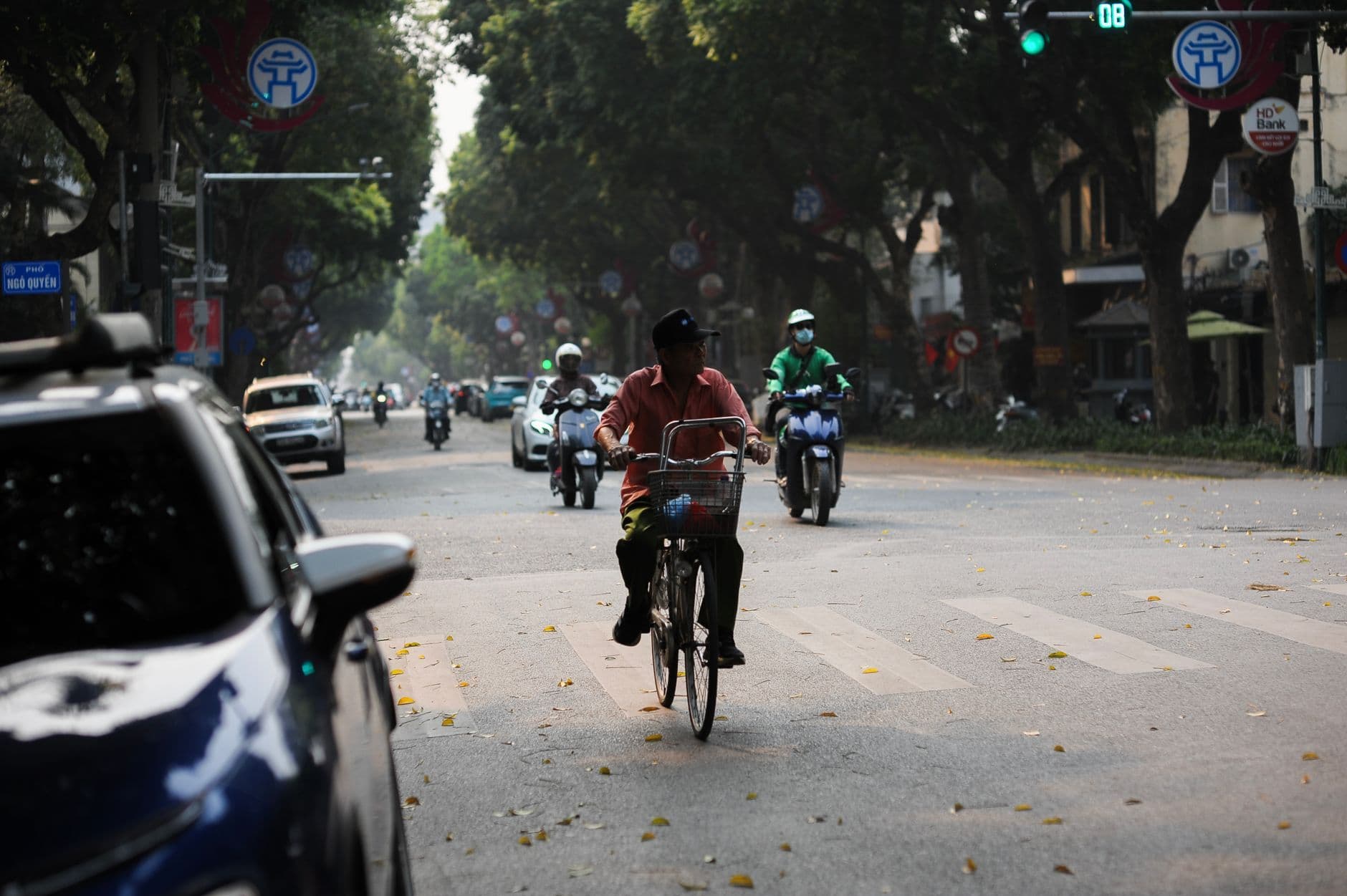
He used motorcycles as a prime example, noting their prevalence in Vietnam is a reflection of practical reality. For a large portion of the population, they remain the optimal choice due to their affordability, flexibility, and independence from fixed schedules.
In his view, travel behaviors will only shift organically when the transportation system offers alternatives that are demonstrably more convenient and suitable. “Some groups adapt to technology very quickly, while others are almost excluded from it,” Dr. Vinh explained. “Whenever policies or technologies change, we need to ask: what transportation options will these groups realistically have?”
He also stressed that AI should be viewed as a tool that cannot replace human decision-making. While initiatives like EV adoption, public transit expansion, and AI deployment are valuable, they must be rigorously evaluated against social indicators, including affordability, accessibility, and their impact on the quality of life for diverse population groups.
As Vietnam navigates this intelligent digital transition, the consensus is that a unified and interoperable transportation data platform is essential for AI applications to function effectively at a systemic level. Simultaneously, policymakers face the critical task of accounting for disparities in public accessibility to ensure the evolution towards smart transportation is an inclusive one.
Top 5 Vietnam business stories in your inbox every morning. Free, no spam.